Falling in Love with the Fundamental
Another edition of the MtL Days, and earlier this fall we were back at the Forum, Bildungscampus Heilbronn to reconnect with science and each other!

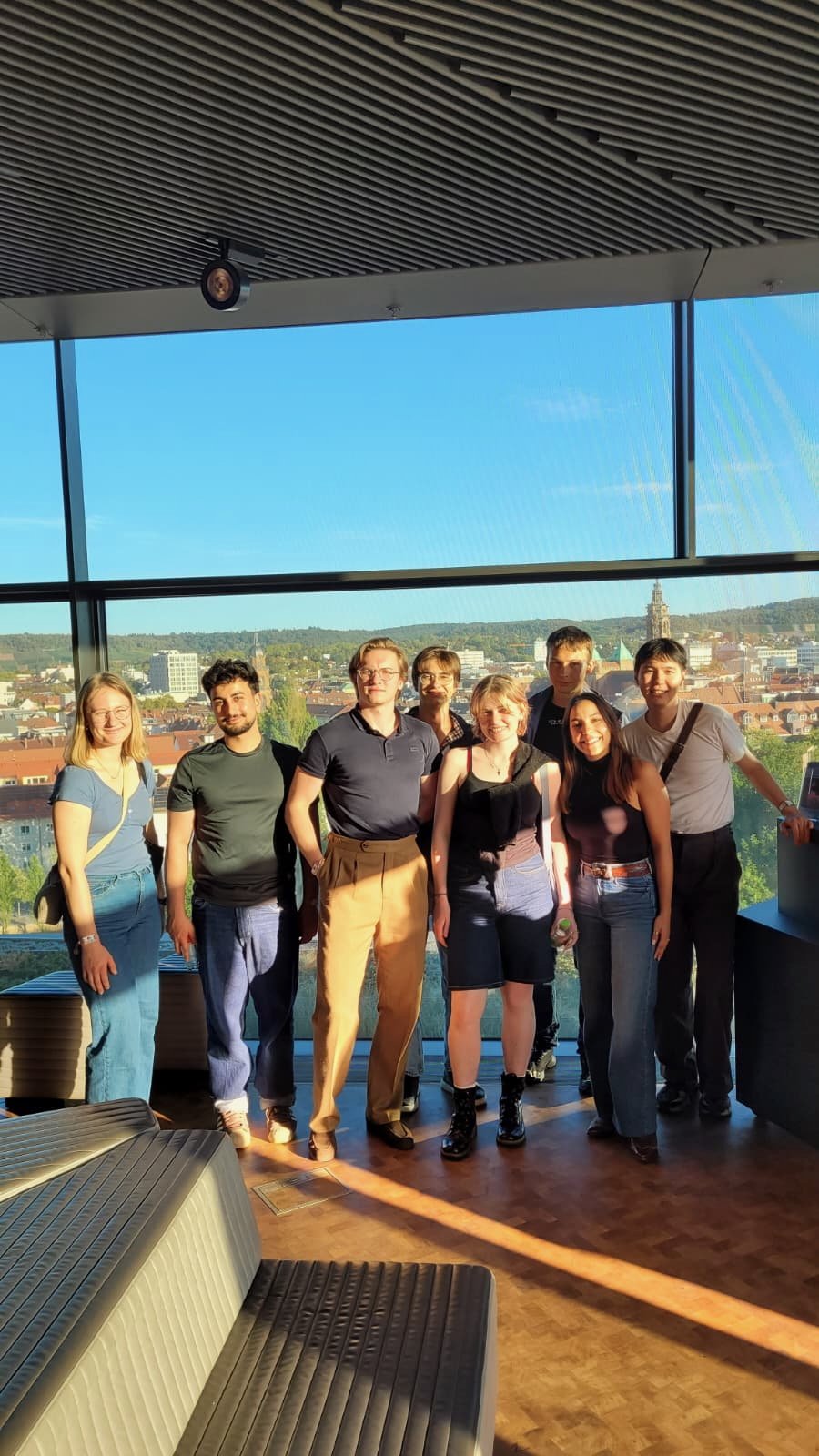
The MtL Fall Days 2026 began, fittingly, with a lot of getting hands-on. Before the official program even started, our students spent a Sunday afternoon at the Experimenta, Heilbronn's interactive science centre, poking, pushing and pulling their way through basic concepts of physics and science. This was a welcome reminder that the fundamentals are not just the foundation of what we do; they are also, quite simply, fun. That spirit carried straight into the two days that followed at the Bildungscampus, which opened with a welcome from Joachim Spatz and a look at the vibrant scientific ecosystem taking shape in Heilbronn, including the planned IPAI space.
What can we learn by building things from the ground up?
Marcos Conde-González and Chandan Muni Reddy showed how de novo design can create small proteins with new enzymatic abilities, from β-hairpin miniproteins to peptides built around alternative metals. Roey Elnathan introduced nanosyringes that inject cargo directly into cells, with applications that include engineering CAR-T cells and stem cells, while Daniela Duarte Campos took the design principle to the tissue scale and described how a cornea can be printed layer by layer. Joachim Spatz framed the bigger picture: understanding cellular systems is one thing, but building life-like systems is where the real insight comes from.


The Power of Simple Ideas
Isabella Graf asked why sensing and decision-making in biological systems so often need to be collective, and what cells gain by pooling information instead of acting alone. Timo Betz then made the case that soft matter physics explains so much of life because, at heart, so much of life can be thought of as polymers. Using the fluctuation-dissipation theorem, he showed that just three parameters (activity, fluidity and resistance) are enough to capture the viscoelastic properties of a cell. Silvia Vignolini joined us remotely to share her group‘s work on how bacteria can be used to make living materials with the audience. All these presentations were an apt example of the events theme: sometimes the deepest understanding comes from stripping a problem back until only the essentials remain.


The program was not only about listening, of course. The poster sessions, where our Master's students presented their lab rotations and theses, were as lively as ever, with reverberations of ideas and discussions. On the final afternoon, Christian Baron led a workshop on systems thinking built around a game that showed, in a very hands-on way, how much a shared language and shared rules matter when people try to work together. We hope our students take that lesson back to their projects, because building a common grammar is exactly what it takes to communicate and collaborate across disciplines, and that is what Matter to Life is all about.

